
Real Assets for the AI Economy
Artificial intelligence is driving the largest capital reallocation in business history. The five largest technology companies are projected to spend nearly $700 billion on capital expenditure in 2026 — roughly 60 percent more than in 2025.i, ii AI inference costs are falling roughly tenfold per year. The cost of cognitive work — software development, financial modeling, customer service, content creation — is collapsing.
That capital does not materialize as software in the cloud. It materializes as power plants, electrical grid upgrades, data centers, cooling systems, and transmission lines. Every dollar of AI investment creates a corresponding demand for physical infrastructure — and the companies that own that infrastructure are among the principal beneficiaries of the AI buildout.
HALO — Hard Assets, Long-duration, Low Obsolescence — is the structural investment opportunity that the AI economy has created. It explains why the physical infrastructure the AI transition depends on offers a combination of growth, income, and resilience that few other asset classes can match.
The AI economy has a physical problem. The capital commitment driving this transition — nearly $700 billion from the five largest technology companies in 2026 alone — does not materialize as software in the cloud. It materializes as power plants, electrical grid upgrades, data centers, cooling systems, and transmission lines. The AI transition is, at its foundation, an infrastructure story. And infrastructure has owners.
For three years, investors positioned for AI through technology stocks: semiconductors, hyperscalers, software platforms. That positioning was logical and profitable. But it captured only part of the opportunity — the part that runs on code. The part that runs on concrete, copper, and kilowatts has been systematically undervalued.iii
HALO — Hard Assets, Long-duration, Low Obsolescence — describes the category of businesses that own and operate that physical foundation. Regulated utilities generating the power. Grid operators transmitting it. Data center REITs housing the compute. Transportation and water networks serving the broader economy. These businesses share three characteristics: their revenues are contracted or regulated, their assets are irreplaceable, and their relevance to the AI economy is growing, not shrinking. And critically, this opportunity is global — the AI buildout is driving infrastructure investment across Europe, Asia-Pacific, and the Americas, opening a universe of high-quality real asset businesses that domestic-focused allocations typically miss.
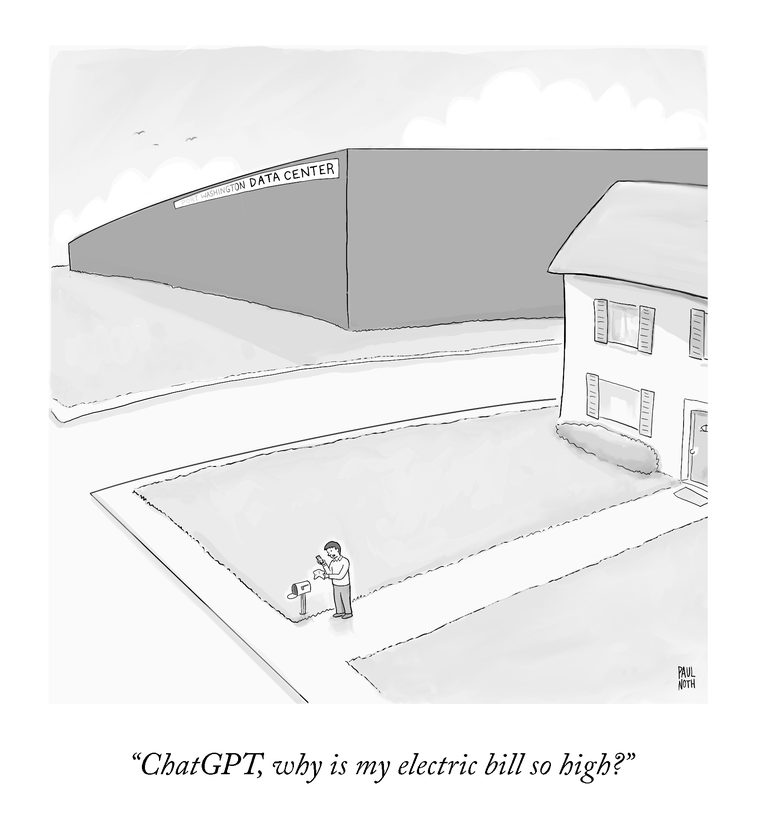
AI’s most binding constraint is not compute — it is electricity. A single large-scale data center consumes as much power as a small city. The International Energy Agency projects that data center electricity demand will more than double by 2030. Every dollar of AI capital expenditure creates a corresponding demand for baseload power generation and reliable grid infrastructure.
AI’s most binding constraint is not compute – it is electricity
The opportunity spans the full energy value chain. Integrated utilities like Iberdrola, Duke Energy, and Enel generate and distribute the power. Transmission operators like Elia Group, National Grid, and Terna build and maintain the high-voltage networks that connect generation to demand. Renewable generators like Engie, Meridian Energy, and Greencoat UK Wind provide the clean baseload that hyperscalers increasingly require under their own net-zero commitments.
These are not glamorous growth companies. They are regulated or semi-regulated businesses with long-duration contracted revenues, inflation-linked tariff structures, and capital return profiles that have compounded through multiple economic cycles. The AI transition does not disrupt them — it increases their relevance.
Beyond energy, the AI economy requires a broader physical foundation. Data center REITs like Equinix and Digital Realty own and operate the facilities that house the compute. As AI workloads grow denser and more power-intensive, the companies that control the physical space, cooling infrastructure, and interconnection points capture an increasing share of the value chain.
Transportation infrastructure moves the physical economy. Union Pacific connects the supply chains. Aena operates the airports. Vinci and Cellnex build and maintain the physical networks — roads, tunnels, telecommunications towers — that the economy runs on regardless of how many workers it employs.
Water utilities like Severn Trent and Essential Utilities provide a service so fundamental that demand is essentially acyclical. Healthcare REITs — Ventas, Primary Health Properties, Aedifica, and Welltower — own facilities serving an aging population whose demand is demographic, not discretionary.
What unites these businesses is that their customers — governments, institutions, regulated entities, aging populations — spend out of necessity, not discretion. If the AI transition erodes consumer purchasing power, these are the last revenue streams to feel it.
Real assets offer something most technology stocks do not: income. In a period of economic transition, where interest rate paths are uncertain and equity valuations are stretched in parts of the market, the ability to generate a reliable and growing income stream from infrastructure assets provides portfolio stability that pure growth exposure cannot replicate.
Many of these companies operate under regulatory frameworks that link returns to invested capital, creating a structural incentive to deploy capital into precisely the kind of infrastructure the AI transition demands. When a regulated utility builds grid capacity to serve a new data center, it earns a return on that capital for decades. The AI buildout is not a headwind for these businesses — it is a growth catalyst operating within a regulated return framework.
Investors have taken to calling this the HALO trade. It is a misnomer. The word “trade” implies a tactical position — something you enter on a catalyst and exit when it resolves. A geopolitical spike. A rate cut. A sector rotation. But the drivers of HALO are not event-driven. AI power demand compounds annually regardless of what oil is doing. Infrastructure underinvestment accumulated over decades does not reverse when a crisis de-escalates. The energy transition requires trillions in real asset deployment that no ceasefire or Fed pivot will cancel. What looks like a trade is a structural reallocation — capital recognizing, perhaps belatedly, that the physical economy cannot be arbitraged away.
The infrastructure businesses described above share another quality beyond their role in the AI buildout — they are structurally insulated from the economic disruption that AI may create. That distinction matters. An investment that benefits from the AI transition but is also vulnerable to its consequences is a more complicated bet than it appears. Real assets are different. The same characteristics that make them essential to the AI economy also make them resilient to its risks.
In the workplace, AI is already showing measurable productivity improvements; fewer employees are necessary to get the job done. When AI replaces a $75,000 worker, the margin improvement is real and immediate. Multiply that across millions of jobs and you get spectacular earnings growth — for a while. But that $75,000 was also someone’s spending. It paid a mortgage, funded grocery bills, covered a car payment. Aggregate the displacement across an economy and you are simultaneously improving the supply side and eroding the demand side.
The consumer demand question will eventually be resolved — through policy, through new distribution mechanisms, through adaptation. But the timing is uncertain, and the resolution may take a decade or more. In the interim, the companies best positioned are those least dependent on discretionary consumer spending.
People need electricity, water, healthcare, and transportation regardless of how the economy is restructured.
Real asset businesses are uniquely resilient to this uncertainty for three reasons:
Utilities operate under regulatory frameworks that guarantee returns on invested capital. Infrastructure operators hold long-duration concessions. REITs have lease structures measured in years and decades, not quarterly subscription renewals. These revenue streams do not depend on the next earnings cycle or the next consumer confidence survey.
The customer base for power generation, grid infrastructure, transportation networks, and healthcare facilities includes governments, municipalities, hyperscale technology companies, and institutional operators. Their spending is driven by demographic necessity, regulatory mandate, and long-term capital planning — not by whether displaced workers can afford to spend.
People need electricity, water, healthcare, and transportation regardless of how the economy is restructured. The demand for these services is not discretionary. It is not cyclical in the way that consumer electronics or restaurant spending is cyclical. In a world where the path from production to consumption is being redrawn, essential services are the last category to be affected.
This does not mean real assets are immune to all risk. Rising interest rates can pressure valuations. Regulatory changes can affect returns. Construction costs can overshoot. But the specific risk that the AI transition may create — an erosion of consumer purchasing power that threatens companies dependent on discretionary spending — is the one risk these businesses are structurally positioned to withstand.
This is the core of the GARA proposition. The Guinness Atkinson Real Assets Income ETF (GARA) is not a bet on which technology wins or how quickly automation displaces workers. It is a bet on the physical infrastructure that the AI economy cannot function without — and on the durability of the income those assets generate through whatever transition follows. In a period of genuine economic uncertainty, that combination of growth exposure and structural resilience is rare. We believe it is also undervalued.
The AI transition is not just a technology story. It is an infrastructure story. The question is whether your portfolio is positioned for both.
Concise notes on the themes shaping our funds, delivered when we publish.