How Korea built the foundation for an enduring growth engine.
By late 2025, social posts tagged “K-Beauty” or “Korean skin care” were drawing about 250 million views a week.1 The social media numbers are flashy, but they don’t tell the full story. K-Beauty isn’t just a social media phenomenon; it is a fast-growing industry built on a solid foundation.
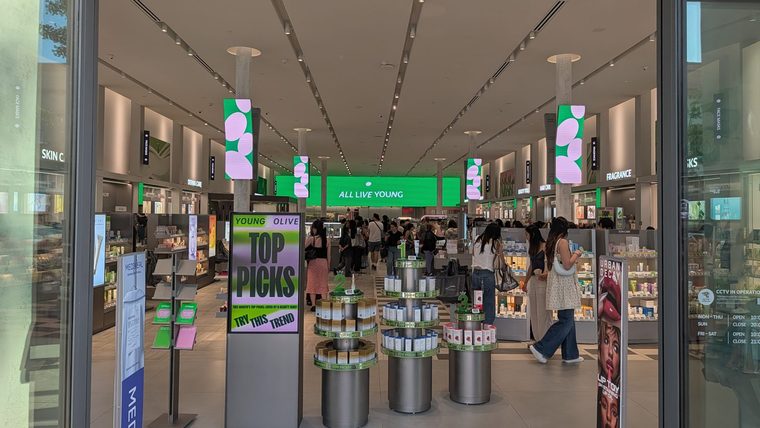
In May 2026, when Olive Young, Korea’s largest beauty retailer2, opened its first US store in Pasadena, shoppers camped overnight on Colorado Boulevard, and by opening time the line stretched roughly a quarter mile across four blocks. Those who arrived at nine in the morning waited up to four hours to get through the door.3 Opening weekend saw 6,000 shoppers.4
The trade data tell the same story. Korea sold $156 million of cosmetics to the United States in 2014; in 2025 it sold $2.2 billion.5 In 2024 it passed France to become the largest supplier of skincare and make-up to the American market, and a year later nearly a quarter of those US imports came from Korea.6
In 2025 Korea’s cosmetics exports reached a record $11.4 billion, carrying the country past the United States to become the world’s second-largest cosmetics exporter, behind only France.7 A decade earlier the figure was $2.9 billion.8 The momentum has since accelerated: in the first nine months of 2026, exports rose 31.1% to $11.1 billion, nearly matching the previous full-year record in three quarters, with the United States the top buyer at $2.35 billion, up 40.6%.9
US retail sales of Korean beauty reached $2.8 billion in early 2026, up roughly 48% year-on-year — and accelerating, from growth in the mid-40s the year before.10 More telling still, K-Beauty products had by then reached 28.7% of US households — more than one home in four with a Korean product on the shelf. “K-Beauty has moved beyond trend status to become one of the clearest examples of how regional beauty innovation can translate into global growth,” said Tara James Taylor, who leads NielsenIQ’s global beauty and personal care business.11
This report traces how that happened: how a nation turned its culture into an export engine, how its factories learned to convert attention into product in months rather than years, and who collects the profits as the category moves from phone screens into the stores where about half of all beauty is still sold.
Korean beauty looks like it arrived from nowhere. It did not. What surfaced overnight rests on a foundation the country began laying in the 1990s.
Korea had presciently decided that culture was an industry. A Cultural Industry Bureau was created in 1994, and after the 1997 financial crisis the effort accelerated sharply. In his 1998 inaugural address, Kim Dae-jung declared that “the cultural industry is a key industry of the 21st century.” The following year a framework act made export competitiveness a statutory objective, backed by a promotion fund.12 The appeal is easy to see: culture is a capital-light export. A song or a drama, once made, sells into a hundred markets at almost no additional cost — no raw materials, no second factory.
The policy didn’t start the Korean Wave — the global spread of Korean film, TV and music — but it helped it travel: the wave was already building abroad, and the government backed it with funding, export support and infrastructure. The policy wasn’t designed to sell cosmetics. Korea built a runway for its culture; the beauty boom took off on its own.13
The factories came earlier still, and they are the quieter half of the story. Kolmar Korea introduced the contract-manufacturing model to Korean cosmetics in 1990; Cosmax followed in 1992.14 In 1999 the country enacted the Cosmetics Act, which took effect in 2000, and created a distinct legal category for “functional” cosmetics — products permitted to make specific efficacy claims only if they meet the Ministry of Food and Drug Safety’s standards for safety and effectiveness, either by using ingredients it has already approved or by submitting their own data for review.15 Korea set a regulatory standard for efficacy claims two decades before ingredient labels became social-media currency. The retail segment grew in parallel with the manufacturers: Olive Young opened its first store in 1999, had more than 1,000 by 2017, and had more than 1,380 at the end of 2025.16
The Korean beauty industry runs on a shared industrial system, and that system is the durable competitive advantage. It delivers two things that normally trade against each other — speed to market and manufacturing quality — and it delivers them to any brand willing to rent them.
Speed comes from not having to build anything. A Korean brand needs neither a laboratory nor a factory; it rents both. The contract manufacturers keep libraries of ready-made, stable formulations a brand can select and customize, handle the regulatory work and the packaging, and will accept orders as small as a thousand units — small enough to test an idea rather than bet the company on it.17 Cosmax’s founder says the company can supply a brand in as little as three to six months from the first idea; in other markets, he says, that can take a year to three years.18 Kolmar reports the same three-to-six-month range for its ready-made formulation service.19 A peer-reviewed case study of Cosmax describes precisely this machinery — sensing what customers want, designing to it, competing on operational speed — and traces how the company grew into the world’s largest cosmetics contract manufacturer.20
Quality comes from the same factories, and from the law. Renting production would be a poor bargain if it meant accepting weaker product, and the evidence runs the other way: the global majors outsource to these plants themselves. Cosmax’s own disclosures describe work for 18 of the world’s top 20 beauty companies, and Korean-made formulations sit inside some of the most prestigious labels in the industry.21 Behind that stands the regulatory choice Korea made in 1999, when it created a legal category for cosmetics permitted to claim, and required to substantiate, that they actually work.22 An industry built around provable efficacy produces manufacturers who can prove things — which is why “made in Korea” travels as a mark of competence rather than a compromise on price.
Together they let the industry answer the market in real time. When beauty influencers pointed out that a viral Korean cushion foundation came in too few shades, the brand expanded the range to forty and went on to lead its category on Amazon.23 And none of this is a talent any single brand possesses. It is infrastructure — thirty years old, available to all of them, and behind the world’s second-largest cosmetics exports.
K-Beauty is not a single business. The industry spans four segments of a value chain — the brands, the manufacturers who make their products, the distributors who move them, and the aesthetics companies that extend the routine into the clinic — and the economics of each are different.
The brands capture the upside when a label breaks out: APR, the owner of Medicube, more than doubled its revenue in 2025, with the US now over a third of sales.24 Results across the segment vary widely from one company to the next.
The manufacturers are the engine room. Most viral indie brands outsource production to the same handful of Korean contract manufacturers, who develop and make products for brands across the industry.25
The distributors give Korean brands reach in more than 200 countries, online and on store shelves: Silicon2, which distributes Korean beauty brands worldwide, grew revenue 61% in 2025.26
The aesthetics companies extend the theme into the clinic — devices, injectables and skin boosters, several of them Korean-led — and they include some of the highest operating margins in the industry.27 They also have an unexpected tailwind: GLP-1 weight-loss drugs can leave patients with facial volume loss and lax skin, and the boosters, devices and fillers that treat them are the kind of products Korean aesthetics companies make.28
For all the records already set, the category has barely begun to reach the stores where about half of all US beauty is still bought.29
Roughly three-quarters of K-Beauty’s North American sales still happen online, much of it on platforms such as TikTok Shop and Amazon.30 The move into physical retail — the shelves, the malls, the department stores where the mass market shops — is only now beginning. Sephora has partnered with Olive Young to bring Korean beauty into its stores, and Target quadrupled its K-Beauty range in spring 2026.31 The crowds in Pasadena suggest how much demand is waiting for those shelves.
The penetration figure says the same thing from another angle. A category that has already reached more than one in four US households, while still selling mostly online and through a handful of newly opened doors, has a long runway simply to be sold where people shop. One Wall Street analyst projects US K-Beauty sales of about $4 billion in 2026.32
Beyond the US, the pattern is earlier still. Korean cosmetics now reach 202 countries, up from 172 a year earlier, and the US accounted for less than a quarter of 2025’s export growth.33 Global K-Beauty sales rose 53% year over year in NielsenIQ’s July 2026 report, and the firm calls the growth “broad-based”: sales rose 58% in Western Europe, where Korean brands now account for around 10% of online skincare sales and 15–20% in Italy, Spain and France, and 135% in Brazil and Mexico.34 In the first half of 2026, Europe overtook North America as a destination for Korean cosmetics exports for the first time.35
Trade friction. Tariffs are a risk for any export industry, and US trade policy has changed often and quickly. Rates on Korean goods, and on goods from Korea’s competitors, have shifted several times since 2025 and could shift again. Higher tariffs could raise prices for American shoppers or squeeze margins for Korean companies. The US, though, takes less than a fifth of Korea’s cosmetics exports.36
Trading down. The same low prices that win shoppers could, at scale, deflate the category’s economics. One analyst warns that $20-to-$30 Korean products may compress average selling prices across skincare and make it harder to trade younger buyers up to the $100-plus prestige tier they might otherwise have entered.37 What is a strong value proposition for the consumer can be a margin risk for the industry.
Markets versus fundamentals. Finally, a caution for investors: strong fundamentals and strong share prices are not the same thing. Korean equities can be volatile, most of the industry’s listed companies trade in won, so currency moves affect returns for US investors, and share prices can rise or fall regardless of how well the underlying businesses are doing. A wonderful industry and a wonderful investment are related questions, not identical ones.
Step back from the month-to-month noise and the shape is clear. A curiosity that arrived as a set of viral routines has become an $11.4 billion export industry, the world’s second-largest, sold in 202 countries and the leading supplier of skincare and make-up to the United States. It earns across brands, manufacturers, distributors and aesthetics companies rather than resting on any single label. Underneath it sit thirty years of construction: the culture that creates the demand, the factories that convert it in months, the law that sets the standard for claims.
What makes the timing interesting is that the loudest evidence is also the freshest. The household penetration is real but the shelves are still filling; the export records are set but the stores are new; the world outside America is earlier still. Three decades of construction produced an industry that arrived looking like an overnight success. The foundation took thirty years to build. The growth that it supports is just getting started.
Concise notes on the themes shaping our funds, delivered when we publish.